Wine QR Code Generator vs Digital Label Platform: What's the Difference?
Compare a basic wine QR code generator with a purpose-built digital label platform and learn what wineries should consider for label management, updates, compliance information, translations, and QR codes.

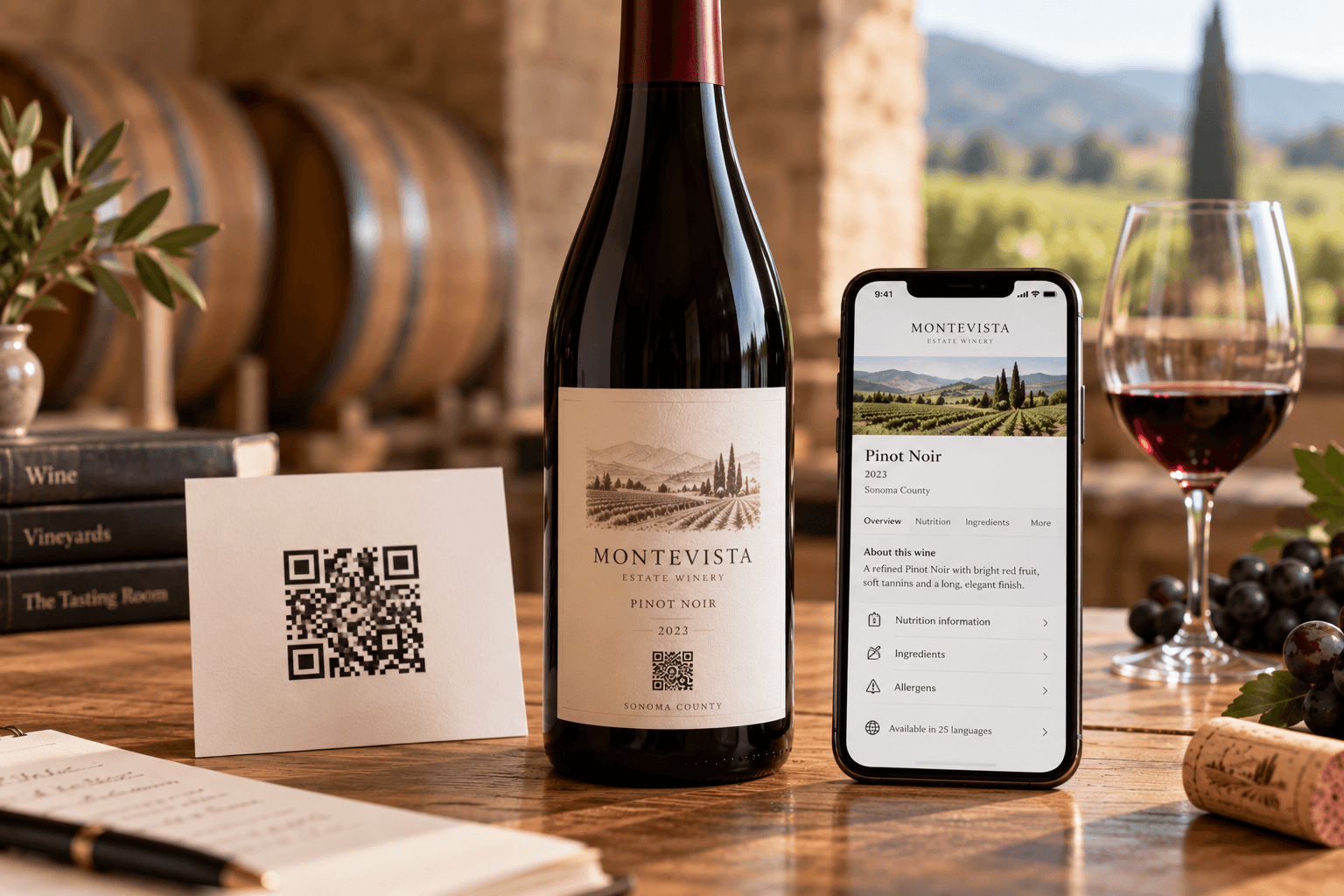
A QR code is easy to generate.
But for a winery, generating the square graphic is often only the beginning.
The more important question is what happens after someone scans it.
A basic QR code generator and a purpose-built digital wine label platform can both produce QR codes, but they solve different problems. One primarily creates a link between a physical object and an online destination. The other is designed to help wineries manage the wine information behind that link.
If you are evaluating options for your bottles, understanding that distinction can help you choose the right tool.
What does a basic QR code generator do?
At its simplest, a QR code generator takes information, often a URL, and turns it into a scannable code.
You provide the destination, generate the code, download it, and add it to your label or other printed material.
For a simple use case, that may be all you need.
For example, if a winery wants a QR code that sends visitors to its existing website, online shop, or event page, a general-purpose generator may be enough.
The QR code itself does not need to understand anything about wine.
But when the goal is to provide and manage structured information about individual wines, the workflow becomes more complicated.
What is a digital wine label platform?
A digital wine label platform goes beyond generating the QR image.
It gives the winery a system for creating and managing the information consumers see after scanning.
Instead of starting with:
"What URL should this QR code open?"
you can start with:
"What information does this wine need to provide?"
With Winetraqr, for example, a winery creates a wine and enters its product information. Winetraqr then generates a QR code linked to that wine's mobile-optimized digital label.
If the wine information needs to be updated later, the digital label can be updated without replacing the QR code already printed on the bottle.
That difference becomes increasingly important as a winery manages more wines, vintages, markets, and labels.
QR code generator vs digital label platform at a glance
| Basic QR code generator | Digital wine label platform | |
|---|---|---|
| Generates a QR code | Yes | Yes |
| Links to an online destination | Yes | Yes |
| Provides a wine-specific digital label | Not necessarily | Yes |
| Organizes information by wine | Not typically its main purpose | Yes |
| Lets wine information be managed in one system | Not typically | Yes |
| Supports structured ingredient and nutrition information | Depends on the destination you build | Designed for this use case |
| Mobile-optimized wine information | Depends on the destination | Yes |
| Wine-specific multilingual experience | Requires another solution or workflow | Can be built into the platform |
| Manage multiple wines from one dashboard | Not typically | Yes |
| Wine-specific scan analytics | Depends on the service | Can be available |
| Winery marketing tools | Depends on the service | Can be available |
The exact capabilities of general QR code services vary, so wineries should compare individual products rather than assuming every QR generator works the same way.
The broader difference is the workflow.
A QR generator focuses on creating the code. A digital label platform focuses on managing the information and experience connected to it.
1. Think about what happens after the scan
The QR code itself contains very little of the experience.
What matters to the consumer is the page that opens.
If you use a basic QR generator, you still need somewhere to host the information you want consumers to see. That could mean building and maintaining pages on your own website or using another system alongside the QR generator.
A digital label platform combines those steps.
Winetraqr generates a QR code for a wine and connects it to a mobile-optimized digital label containing the wine information managed in the platform.
That gives the winery one workflow for both sides of the scan.
2. Consider how often wine information changes
Printing a QR code onto thousands of bottles makes the destination behind it important.
If information changes, you do not want every correction to become a printing problem.
With Winetraqr, wineries can update their wine details and have the digital label reflect those changes without reprinting the QR code.
This can be useful when correcting information or maintaining a digital label before and after a release.
There is an important operational consideration, however.
Updating a digital destination does not mean wineries should overwrite information that still needs to remain accurate for bottles already in circulation. Different vintages or materially different products may need to be managed separately.
The benefit is flexibility, not a reason to treat every release as the same wine record.
3. Think beyond one bottle
A QR generator can feel perfectly manageable when you have one URL and one QR code.
A winery may have considerably more to organize:
- Multiple wines
- Different vintages
- Different product information
- Multiple brands or wineries
- Different QR code placements
- New releases over time
At that point, organization becomes part of the problem.
Winetraqr is built around wines rather than individual QR-code files. Wineries can manage their wines and digital labels from a central account, with unlimited wines and QR codes available on the current free plan.
That makes the QR code one part of a broader label-management workflow rather than a standalone asset sitting in a downloads folder.
4. Consider multilingual information
Wine frequently crosses borders.
If you build the destination behind a QR code yourself, managing translations may become another part of the workflow.
Winetraqr automatically translates digital labels into 25 languages, including all official EU languages supported by the platform.
For wineries selling across European markets, having multilingual functionality within the digital-label workflow can reduce the need to create and maintain separate pages manually.
It is still important to review wine names, terminology, and other product-specific information where appropriate.
5. Look at how your team will manage labels
The right solution should also fit the people responsible for maintaining the information.
If one person creates a few QR codes once a year, a simple workflow may be enough.
A growing winery may need several people involved in label management.
Winetraqr's Premium plan includes team functionality so wineries can invite and manage teammates. The platform also supports managing multiple wineries from the same account.
This becomes less about generating QR codes and more about having a consistent place for the winery team to manage digital labels over time.
6. Decide whether you need more than one QR code for a wine
One wine does not always mean one QR code.
A winery might want separate codes for different placements or campaigns while keeping them connected to the same wine information.
Winetraqr Premium supports multiple QR codes for the same wine. Those QR codes can be managed separately while continuing to point to the wine's current information.
This can be useful when a winery wants different QR codes for bottles, printed materials, events, or other placements without maintaining duplicate wine information.
A basic QR generator can also generate multiple codes, of course. The difference is whether those codes are managed as part of the wine record or simply exist as separate QR assets.
7. Decide whether scan analytics matter
Some QR code services offer analytics, so analytics alone are not what defines a digital label platform.
The question is whether those insights are connected to the winery's label-management workflow.
Winetraqr offers optional scan analytics and reporting as a Premium feature. Its current analytics tools provide information about scan activity, including how often labels are scanned and geographic engagement.
For wineries that want to understand how consumers interact with their QR codes, having those insights alongside the wines and QR codes can be more convenient than combining separate systems.
8. Keep compliance and marketing use cases clear
A winery may want QR codes for several different reasons.
One could provide required product information. Another could lead visitors to the winery story, shop, social profiles, or tasting bookings.
Those purposes should not automatically be combined.
For wines subject to EU e-label requirements, electronic mandatory product information has specific rules, including restrictions around sales and marketing content.
Winetraqr therefore treats the compliance label and winery marketing experience as distinct use cases for EU wineries. Its Premium marketing pages provide wineries with a separate branded digital destination, and a secondary QR code can be used for that marketing content.
A general QR code generator can certainly send visitors to either destination.
The difference is that a wine-specific platform can help organize those experiences around the winery's actual wines and workflows.
When is a basic QR code generator enough?
A basic QR generator can make sense when your needs are genuinely simple.
If you already have the destination page built and maintained elsewhere, and you only need a scannable code that sends visitors there, adding another platform may be unnecessary.
For example, a winery might simply want a QR code on a tasting-room poster that links to an existing event page.
In that situation, the QR code is the problem you need to solve.
When does a digital wine label platform make more sense?
A digital label platform becomes more useful when the information behind the QR code is the real problem.
Consider a purpose-built platform if you need to:
- Create digital labels for multiple wines
- Manage ingredient and nutrition information
- Update wine information without replacing the printed QR code
- Provide mobile-friendly wine information
- Support multiple languages
- Keep wines and QR codes organized in one place
- Give teammates access to label management
- Create multiple QR codes for the same wine
- Review scan analytics
- Manage separate winery marketing experiences
Not every winery needs every feature.
The value comes from bringing the parts you do need into one wine-specific workflow.
Don't choose based on the QR code alone
If two tools can both generate a QR code, they can look similar at first.
But the QR image is not where most of the ongoing work happens.
The real questions are:
Where does the QR code lead?
Who manages the information behind it?
How do you update it?
How do you organize dozens of wines over time?
How will consumers access that information across different languages and devices?
For a simple link, a QR generator may be all you need.
For wineries managing digital product information across wines, vintages, and markets, a purpose-built digital label platform can provide a more complete workflow.
Create and manage digital wine labels with Winetraqr
Winetraqr is built specifically for wineries that need to connect physical wine labels with digital product information.
The free plan currently includes unlimited wines and QR codes, automatic language translation, mobile-optimized digital labels, and the ability to update label information when needed.
Wineries that need additional tools can upgrade for features including multiple QR codes per wine, team management, marketing pages, and scan analytics.
Create your free Winetraqr account and build your first digital wine label.
Unlock the story behind every bottle
- Unlimited wines and QR codes
- Automatic language translation
It's free to sign up. No credit card needed.